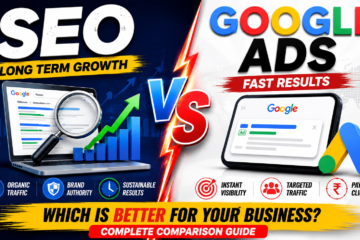

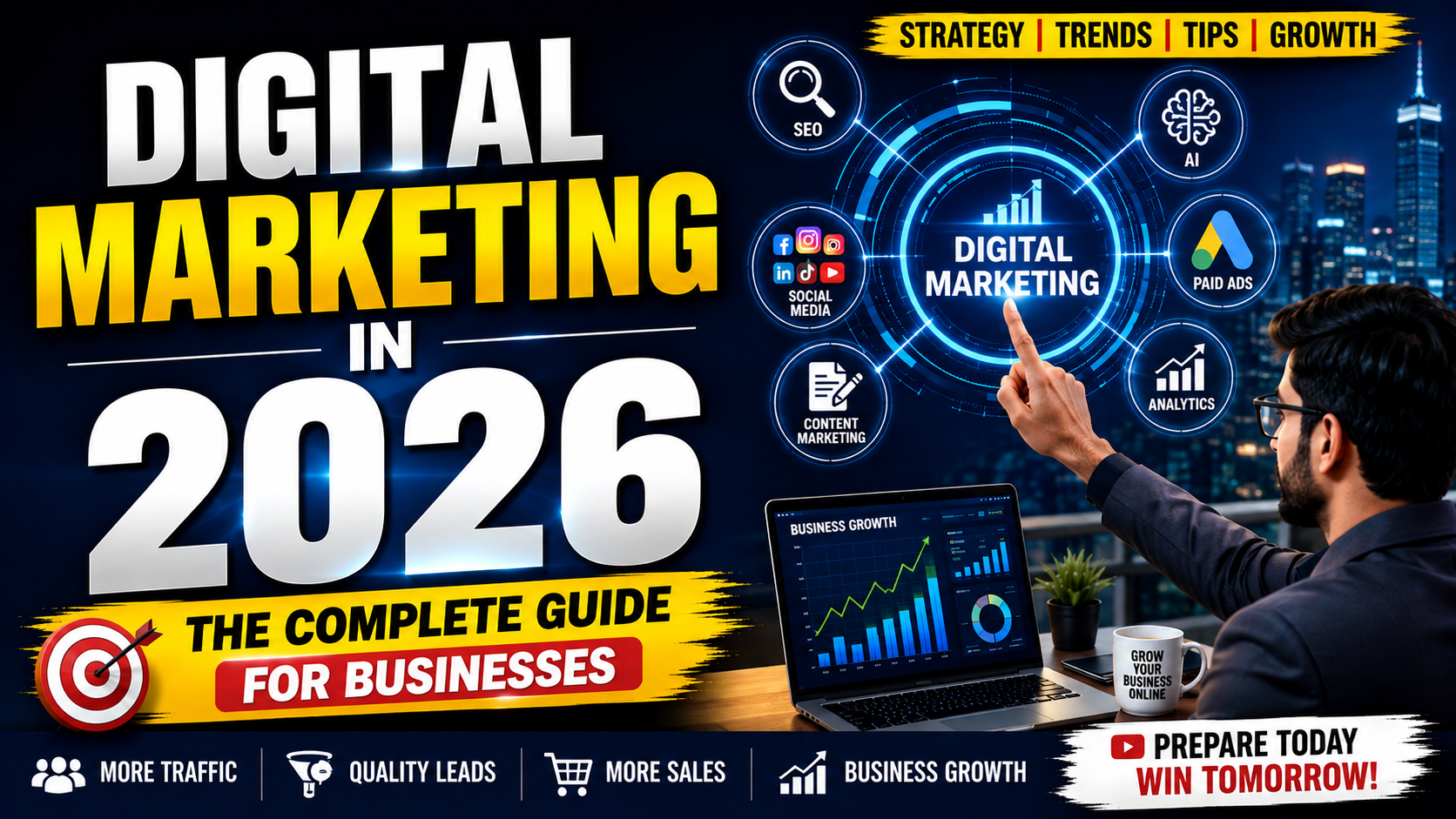
Digital marketing in 2026 is no longer simply about running ads or posting regularly on social media. Businesses now need an integrated digital strategy that combines SEO, AI, content marketing, social media, paid advertising, websites, analytics, automation and customer experience.
Search itself is also changing. Google now includes AI-powered experiences such as AI Overviews and AI Mode, but Google says the fundamentals of SEO remain important: technically accessible websites, helpful people-first content, strong internal linking, good page experience and quality media continue to matter.
For startups, local businesses, professionals and established brands, 2026 is an opportunity to build a stronger digital presence and turn online visibility into measurable business growth.


What Is Digital Marketing?
Digital marketing is the process of promoting a business, product or service through digital channels.
These channels can include:
- Search engines
- Websites and blogs
- Social media
- Google Ads and other paid advertising
- Email marketing
- WhatsApp and messaging platforms
- Video platforms
- Content marketing
- Influencer marketing
- AI-powered marketing tools
The goal isn’t simply to get more views or followers. A successful digital marketing strategy should ultimately help a business attract the right audience, generate leads, increase sales and build long-term customer relationships.
Why Digital Marketing Matters More in 2026
Customers increasingly research businesses online before making purchasing decisions.
A potential customer may:
Search Google → Visit your website → Check Instagram → Read reviews → Watch videos → Compare competitors → Contact your business → Make a purchase.
This means businesses need to maintain a consistent presence across multiple digital touchpoints.
At the same time, search is becoming more conversational and AI-assisted. Google says AI Overviews and AI Mode can surface links from a broader range of relevant websites, creating new opportunities for businesses that publish useful, trustworthy content. (Google for Developers)
1. SEO in 2026: Focus on People, Not Just Keywords
Search engine optimization remains one of the most valuable long-term digital marketing strategies.
However, SEO in 2026 is much more than inserting keywords into articles.
Businesses should focus on:
- Helpful and original content
- Search intent
- Technical SEO
- Website speed and usability
- Internal linking
- Local SEO
- High-quality images and videos
- Author expertise and credibility
- Clear website structure
Google’s current guidance specifically emphasizes unique, valuable, people-first content and says there is no special “AI SEO” trick required for AI Overviews or AI Mode. (Google for Developers)
The important question is no longer:
“How many keywords should I use?”
Instead ask:
“Does this page give the customer the best answer to their problem?”

2. AI Is Becoming a Marketing Assistant
Artificial intelligence is transforming the way businesses create and manage marketing campaigns.
AI can help marketers with:
- Content research
- Blog outlines
- Social media ideas
- Ad copy variations
- Customer segmentation
- Email personalization
- Data analysis
- Creative brainstorming
- Competitor research
- Marketing automation
But businesses should avoid simply publishing large amounts of AI-generated content without adding original value.
Google’s guidance says generative AI can be useful for research and structuring content, but generating many pages without adding value can fall under its scaled-content-abuse policies. (Google for Developers)
The winning formula:
AI + Human Expertise + Original Insights + Quality Control
AI should make your marketing team more productive, not make your brand sound generic.
3. Content Marketing Will Remain a Growth Engine
Content gives businesses an opportunity to demonstrate expertise before asking customers to buy.
A strong content strategy can include:
Blog posts
Educational articles that answer customer questions.
Videos
Product demonstrations, tutorials, interviews and educational content.
Reels and Shorts
Short-form content designed for discovery and engagement.
Case studies
Real examples showing how your product or service solved a problem.
Guides
Detailed resources that help customers make better decisions.
Infographics
Visual explanations of complex topics.
Google’s guidance for generative AI search continues to emphasize useful, original content rather than commodity content that simply repeats information already available online. (Google for Developers)

4. Social Media Marketing Is About Community
Having thousands of followers doesn’t automatically mean having a successful business.
In 2026, businesses should focus on building attention + trust + community + conversion.
Your social media strategy can include:
- Instagram Reels
- YouTube Shorts
- LinkedIn content
- Educational posts
- Customer stories
- Behind-the-scenes content
- Testimonials
- Polls and questions
- Live sessions
- Founder-led content
Instead of asking:
“What should we post today?”
Build content pillars.
For example, a digital marketing agency could use:
40% Educational Content
Teach your audience.
20% Authority Content
Show expertise and results.
20% Engagement Content
Start conversations.
20% Promotional Content
Showcase services and offers.
5. Short-Form Video Is Essential
Short-form video has become one of the easiest ways for brands to reach new audiences.
Businesses can create:
🎥 Educational Reels
🎥 Product demonstrations
🎥 Customer testimonials
🎥 Before-and-after videos
🎥 Industry tips
🎥 FAQs
🎥 Behind-the-scenes videos
🎥 Founder videos
🎥 Trending-format content
A simple smartphone, good lighting and a clear message can often be enough to begin.
The key isn’t expensive production.
The key is useful content with a strong first few seconds.
6. Local SEO for Local Businesses
If your business serves a specific city or region, local SEO should be a major part of your strategy.
For example:
- Digital marketing agency in Nagpur
- Best salon in Nagpur
- Website development company in Pune
- Restaurant near me
- CA in Mumbai
Businesses should maintain accurate local business information, encourage genuine reviews and create useful location-specific content.
Google also recommends keeping Business Profile information up to date as part of maintaining visibility across Search and AI features. (Google for Developers)
Local SEO Checklist
✅ Google Business Profile
✅ Correct business name
✅ Correct address
✅ Phone number
✅ Business category
✅ Working website
✅ Updated business hours
✅ Genuine customer reviews
✅ Local landing pages
✅ Location-focused content
7. Paid Advertising: Spend Smarter
Organic marketing takes time.
Paid advertising can help businesses reach potential customers faster.
Common platforms include:
- Google Ads
- Meta Ads
- YouTube Ads
- LinkedIn Ads
- Other industry-specific advertising platforms
But simply increasing the advertising budget doesn’t guarantee better results.
A successful campaign needs:
Right Audience + Right Offer + Right Creative + Right Landing Page + Right Tracking
For example, instead of sending every advertisement to your homepage, create a dedicated landing page for the specific campaign.
8. Your Website Is Your Digital Headquarters
Social media platforms are valuable, but your website remains an important owned digital asset.
A professional website should:
- Load quickly
- Work well on mobile
- Clearly explain your services
- Build trust
- Make contacting you easy
- Include strong calls to action
- Have a logical structure
- Be search-engine accessible
Your website should answer three questions quickly:
Who are you?
What do you offer?
Why should customers choose you?
A visitor shouldn’t have to search through five pages to understand what your company does.
9. Email and WhatsApp Marketing
Not every customer is ready to buy immediately.
Email and messaging can help businesses nurture potential customers.
For example:
Day 1: Welcome message
Day 3: Educational content
Day 7: Case study
Day 10: Product/service explanation
Day 14: Special offer
The goal is to stay relevant without becoming annoying.
Always follow applicable privacy, consent and messaging regulations when collecting and contacting customers.
10. Analytics: Measure What Actually Matters
Marketing without measurement becomes guesswork.
Businesses should track metrics such as:
- Website visitors
- Traffic sources
- Leads
- Conversion rate
- Cost per lead
- Customer acquisition cost
- Sales
- Return on ad spend
- Engagement
- Email performance
- Search visibility
Don’t focus only on likes and impressions.
A post with 10,000 views but zero leads may be less valuable than a post with 1,000 views that generates 20 qualified enquiries.
Think beyond vanity metrics.
Attention → Engagement → Leads → Customers → Revenue
11. Build a Strong Digital Marketing Funnel
A digital marketing funnel helps move people from discovering your brand to becoming customers.
Stage 1 — Awareness
Customer discovers your brand.
Channels:
SEO, Instagram, YouTube, ads, social media.
Stage 2 — Interest
Customer wants to learn more.
Channels:
Blogs, videos, website, guides, social content.
Stage 3 — Consideration
Customer compares your business with alternatives.
Tools:
Testimonials, reviews, case studies, demonstrations.
Stage 4 — Conversion
Customer takes action.
Examples:
Call, WhatsApp, enquiry, booking or purchase.
Stage 5 — Retention
Customer returns and recommends your business.
Tools:
Email, WhatsApp, loyalty programs, customer support and valuable content.
12. Personal Branding Is Becoming More Important
People don’t always connect with logos.
They connect with people.
Founders, CEOs, consultants and experts can use personal branding to build trust.
For example:
Founder + Expertise + Content + Consistency = Authority
A founder could publish:
- Industry opinions
- Business lessons
- Educational videos
- Customer stories
- Behind-the-scenes content
- Industry trends
- Personal experiences
This can make the brand feel more human and trustworthy.
13. Don’t Ignore Reviews and Reputation
Before purchasing, customers often look at what others say about a business.
Your online reputation can influence conversions.
Encourage satisfied customers to leave genuine reviews and respond professionally to feedback.
Never purchase fake reviews or manufacture testimonials.
Your reputation is a long-term business asset.
14. The Biggest Digital Marketing Mistakes in 2026
❌ Posting without a strategy
Posting every day doesn’t automatically create growth.
❌ Buying followers
Fake followers don’t become customers.
❌ Creating generic AI content
AI-generated content without original value can weaken your brand and may create search-quality problems. (Google for Developers)
❌ Ignoring SEO
Social media reach can fluctuate. Search visibility can become a valuable long-term acquisition channel.
❌ Not tracking conversions
If you don’t know which campaign generates customers, you can’t optimize your budget effectively.
❌ Having a poor website
A great advertisement cannot compensate for a confusing landing page.
❌ Focusing only on viral content
Virality is not the same as business growth.

15. A Simple Digital Marketing Strategy for Small Businesses
If you’re starting from zero, don’t try to do everything at once.
Month 1 — Build the Foundation
- Create or improve your website
- Set up Google Business Profile
- Create social media profiles
- Define your target audience
- Identify your main services/products
- Set up analytics
Month 2 — Start Content
Publish:
- 4–8 blog posts
- Regular social media content
- Short-form videos
- Customer FAQs
- Educational posts
Month 3 — Generate Leads
Launch:
- Google Ads or social ads
- Lead-generation landing pages
- WhatsApp enquiry system
- Email follow-up
- Retargeting campaigns where appropriate
Month 4 and Beyond — Optimize
Analyze:
- What’s generating traffic?
- What’s generating leads?
- Which campaigns convert?
- Which content performs?
- Where are customers dropping off?
Then invest more in what works.
What Will Define Successful Digital Marketing in 2026?
The strongest businesses will not necessarily be the ones that publish the most content.
They will be the businesses that create better experiences and more useful information.
Google’s current guidance reinforces this direction: SEO fundamentals remain relevant in AI-powered search, while unique, helpful, reliable and people-first content is increasingly important. (Google for Developers)
The future of digital marketing is therefore not:
AI vs Humans
It is:
AI + Creativity + Strategy + Human Expertise
Businesses that combine these effectively can create faster, smarter and more personalized marketing systems.
Final Thoughts
Digital marketing in 2026 is no longer an optional activity for businesses that want to grow online.
Whether you run a startup, local business, e-commerce store, professional service, educational institute or established company, your customers are already using digital channels to discover, compare and evaluate businesses.
The opportunity is to build a system where:
SEO attracts people → Content educates them → Social media builds trust → Advertising accelerates reach → Your website converts visitors → Analytics improves performance → Retention creates long-term value.
At Digitalspark4u.com, the focus should be on helping businesses move beyond simply “being online” and toward building a measurable digital growth system.
We Spark Ideas, You Get Results.
Frequently Asked Questions
What is digital marketing in 2026?
Digital marketing in 2026 involves using channels such as SEO, AI-assisted marketing, social media, websites, content, paid advertising, email and messaging platforms to attract and convert customers.
Is SEO still important in 2026?
Yes. Google states that foundational SEO best practices remain relevant for both traditional Search and AI-powered experiences such as AI Overviews and AI Mode. (Google for Developers)
How is AI changing digital marketing?
AI can assist with research, content creation, personalization, analysis, automation and campaign optimization. However, businesses still need human strategy, expertise, originality and quality control.
How much should a business spend on digital marketing?
There is no universal budget. It depends on your industry, competition, goals, customer acquisition economics and available resources. Start with measurable campaigns and increase investment when you can demonstrate positive returns.
What is the best digital marketing strategy for a small business?
A strong starting combination is local SEO + professional website + useful content + social media + customer reviews + targeted paid advertising.
📌 SEO Details
Blog Title:
Digital Marketing in 2026: The Complete Guide for Businesses
SEO-Friendly Permalink:/digital-marketing-in-2026-complete-guide-for-businesses/
Meta Description:
Discover the complete digital marketing guide for 2026. Learn how SEO, AI, social media, content marketing, paid ads, websites and analytics can help businesses grow online.
Primary Keyword:
Digital Marketing in 2026
Secondary Keywords:
- Digital marketing strategy 2026
- Digital marketing for businesses
- AI digital marketing
- SEO in 2026
- Digital marketing trends 2026
- Online business growth
- Digital marketing agency
- Digital marketing services