
In today’s competitive digital landscape, businesses need a strong online presence to attract customers, generate leads, and increase sales. Two of the most powerful ways to drive website traffic are SEO (Search Engine Optimization) and Google Ads.
But which one is better for your business?
The answer depends on your goals, budget, timeline, industry, and target audience. SEO and Google Ads work differently, but when used together, they can create a powerful digital marketing strategy.
In this guide, we’ll compare SEO vs Google Ads, explain their advantages and disadvantages, and help you decide which strategy is right for your business.
What Is SEO?
SEO, or Search Engine Optimization, is the process of improving your website so that it appears higher in organic search engine results.
For example, if someone searches:
“Best digital marketing agency near me”
A business that has invested in SEO may appear among the organic search results.
SEO generally involves:
- Keyword research
- On-page SEO
- Technical SEO
- Content creation
- Link building
- Local SEO
- Website optimization
- User experience improvements
The main objective is to attract relevant organic traffic without paying for every click.
What Are Google Ads?
Google Ads is Google’s paid advertising platform that allows businesses to display advertisements on search results and across Google’s advertising network.
For example, when someone searches for:
“Digital marketing agency in Nagpur”
businesses running Google Search Ads may appear at the top of the results with an Ad label.
With Google Ads, businesses can target users based on factors such as:
- Search keywords
- Location
- Device
- Audience
- Interests
- Demographics
- Remarketing behavior
You generally pay when someone clicks on your advertisement, making Google Ads a pay-per-click (PPC) advertising model.
SEO vs Google Ads: The Key Difference
The biggest difference is simple:
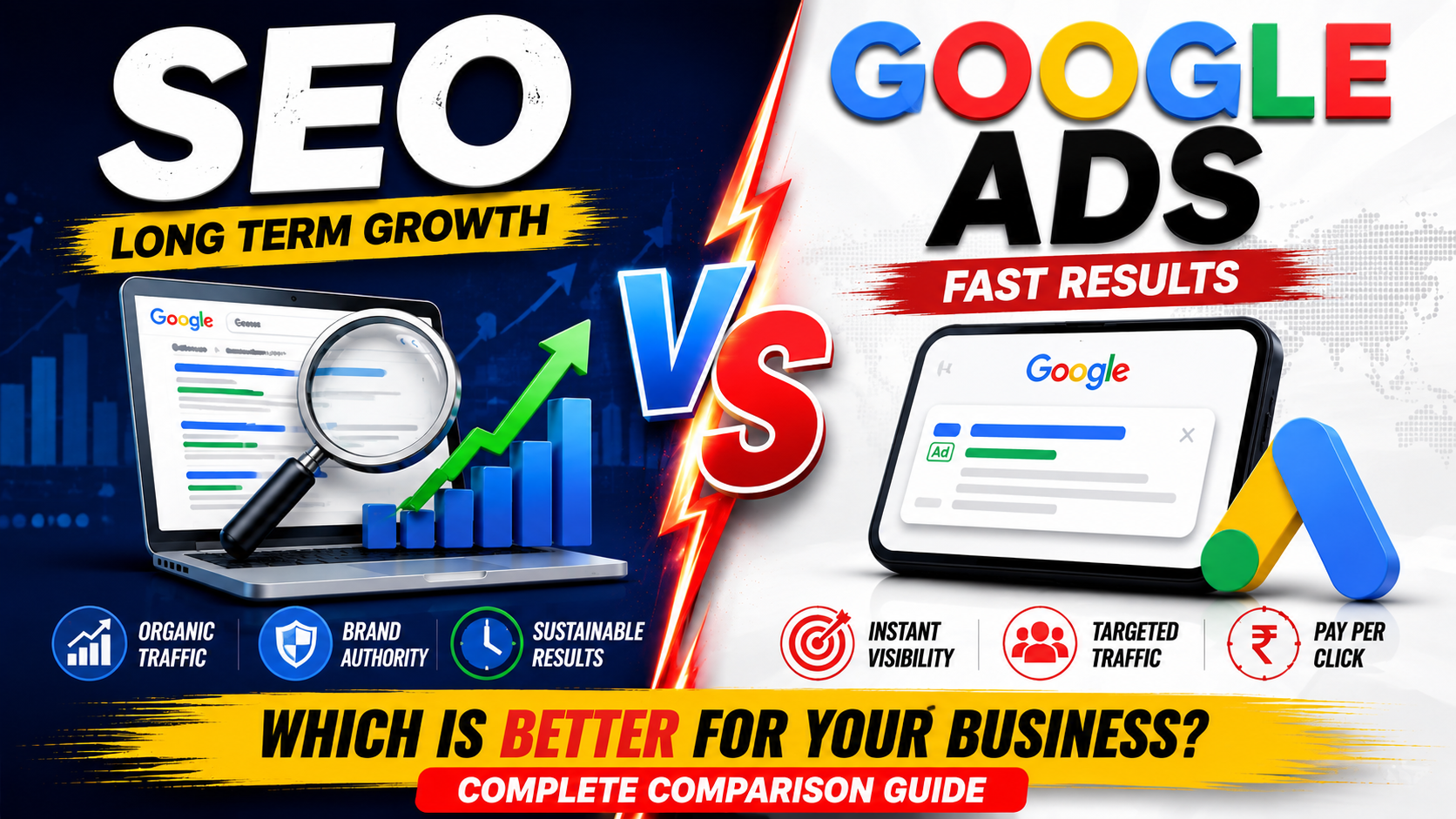
SEO focuses on earning organic visibility, while Google Ads focuses on buying targeted visibility.
| Factor | SEO | Google Ads |
|---|---|---|
| Traffic Type | Organic | Paid |
| Initial Cost | Medium/High effort | Advertising budget |
| Results | Usually slower | Usually faster |
| Long-Term Value | High | Depends on ongoing spending |
| Cost Per Click | No direct CPC | Pay per click |
| Brand Authority | Strong | Moderate |
| Control | Moderate | High |
| Targeting | Keyword/content based | Highly targeted |
| Best For | Long-term growth | Immediate traffic & leads |
1. SEO Provides Long-Term Growth
One of the biggest advantages of SEO is its long-term potential.
A well-optimized blog article, landing page, or service page can continue attracting visitors from search engines months or even years after publication.
For example, a digital marketing agency could create an article such as:
“Complete SEO Guide for Small Businesses”
If the article ranks well for relevant keywords, it can continuously generate:
- Website traffic
- Leads
- Brand awareness
- Potential customers
SEO therefore becomes an investment in your website’s long-term visibility.
2. Google Ads Can Generate Faster Results
SEO generally takes time.
A new website may need months of consistent optimization and content creation before achieving strong organic rankings.
Google Ads can provide visibility much faster.
Once your campaign is properly configured, your advertisement can potentially appear when users search for your targeted keywords.
This makes Google Ads particularly useful for:
- New businesses
- Product launches
- Limited-time offers
- Events
- Lead generation
- Seasonal campaigns
- New websites
If your goal is to generate traffic quickly, Google Ads can be a powerful option.
3. SEO Can Build Trust and Authority
Many users naturally trust organic search results because they are not advertisements.
Ranking organically for competitive keywords can help establish your business as an authority in your industry.
For example, if your website consistently appears for searches related to:
- SEO
- Digital marketing
- Social media marketing
- Google Ads
- Website development
users may begin to recognize your brand as an expert.
This can strengthen your reputation over time.
4. Google Ads Gives You More Immediate Control
Google Ads allows advertisers to control many aspects of their campaigns.
You can decide:
- How much you want to spend
- Which keywords to target
- Which locations to target
- Which landing page users visit
- When ads appear
- Which audiences to target
- Which ads to display
This level of control is particularly useful when a business has a specific marketing objective.
For example, a company launching a new service can create a dedicated campaign and direct users directly to a conversion-focused landing page.
5. SEO Doesn’t Mean “Free Traffic”
A common misconception is that SEO is completely free.
While you don’t pay Google for every organic click, SEO requires investment.
You may need to spend money on:
- SEO professionals
- Content writers
- Website developers
- SEO tools
- Technical optimization
- Link-building activities
- Graphic designers
- Content production
Therefore, SEO is better described as organic traffic rather than free traffic.
6. Google Ads Requires Continuous Budget
Google Ads works differently.
If you stop your advertising campaign, your paid traffic generally stops as well.
For example:
₹20,000/month Google Ads budget → traffic while campaigns are active
When the campaign stops, the advertisements stop appearing.
This doesn’t mean Google Ads is bad. It simply means businesses need to consider advertising as an ongoing acquisition expense.
7. Which Is Better for Small Businesses?
For small businesses, the best approach often depends on the business model and available resources.
SEO may be better if:
- You want long-term growth.
- You have limited advertising budget.
- Your customers regularly search for your services.
- You want to build online authority.
- You can consistently create useful content.
Google Ads may be better if:
- You need leads quickly.
- You have a new product or service.
- You have a specific advertising budget.
- You want highly targeted campaigns.
- You have a strong landing page and conversion process.
For many small businesses, using both strategies together can be more effective than choosing only one.
SEO + Google Ads: A Powerful Combination
SEO and Google Ads don’t have to compete with each other.
They can complement each other.
A business can use Google Ads for immediate traffic while simultaneously building its organic SEO presence for long-term growth.
For example:
Short Term
Use Google Ads to generate immediate leads.
Medium Term
Publish useful content and optimize service pages.
Long Term
Build organic rankings and reduce dependence on paid traffic.
This creates a more balanced digital marketing strategy.
How Google Ads Can Support SEO
Google Ads data can provide useful insights for your SEO strategy.
For example, your advertising campaigns can reveal:
- High-performing search terms
- High-converting keywords
- Customer interests
- Effective ad messaging
- Landing page performance
These insights can help you identify topics and keywords worth targeting organically.
How SEO Can Support Google Ads
SEO can also improve your paid advertising strategy.
A well-optimized website usually provides a better user experience, faster loading times, relevant content, and stronger landing pages.
These factors can contribute to better campaign performance.
Instead of sending every paid visitor to your homepage, you can create dedicated landing pages that closely match the user’s search intent.
SEO vs Google Ads: Which One Should You Choose?
There is no universal winner.
Your choice should depend on your business goals.
Choose SEO if your priority is:
Long-term organic growth + authority + sustainable traffic
Choose Google Ads if your priority is:
Immediate visibility + targeted traffic + faster lead generation
Choose Both if your priority is:
Short-term results + long-term digital growth
For most businesses looking to build a sustainable online presence, a combination of SEO, Google Ads, content marketing, social media, and conversion optimization can create a stronger marketing ecosystem.
Final Verdict
So, SEO vs Google Ads — which is better?
The answer isn’t necessarily one or the other.
SEO is a long-term investment. Google Ads is a fast-growth advertising channel.
If you need immediate visibility, Google Ads can help you reach potential customers quickly. If you want to build lasting organic traffic and authority, SEO should be part of your long-term strategy.
The smartest approach for many businesses is to use Google Ads to capture demand today while investing in SEO to build sustainable traffic for tomorrow.
At Digitalspark4u.com, a strong digital marketing strategy can be built around your business goals, target audience, budget, and growth objectives.
Don’t just buy traffic. Build a digital presence that keeps generating opportunities.
Frequently Asked Questions
Is SEO better than Google Ads?
Not necessarily. SEO is generally better for long-term organic growth, while Google Ads is useful for immediate targeted traffic. The right choice depends on your business goals.
Is Google Ads better for new businesses?
Google Ads can be useful for new businesses that need immediate visibility and leads. However, building SEO alongside paid advertising can help create long-term growth.
How long does SEO take to show results?
SEO results vary depending on competition, website authority, content quality, technical factors, and the industry. SEO generally requires consistent effort over time rather than producing instant results.
Can I use SEO and Google Ads together?
Yes. Using both can be an effective strategy. Google Ads can generate immediate traffic while SEO builds sustainable organic visibility.
Which is cheaper: SEO or Google Ads?
Neither is universally cheaper. SEO requires ongoing investment in content, optimization, and expertise, while Google Ads requires an advertising budget for clicks and conversions.