
AI in Digital Marketing 2026: From Automation to Intelligent Growth
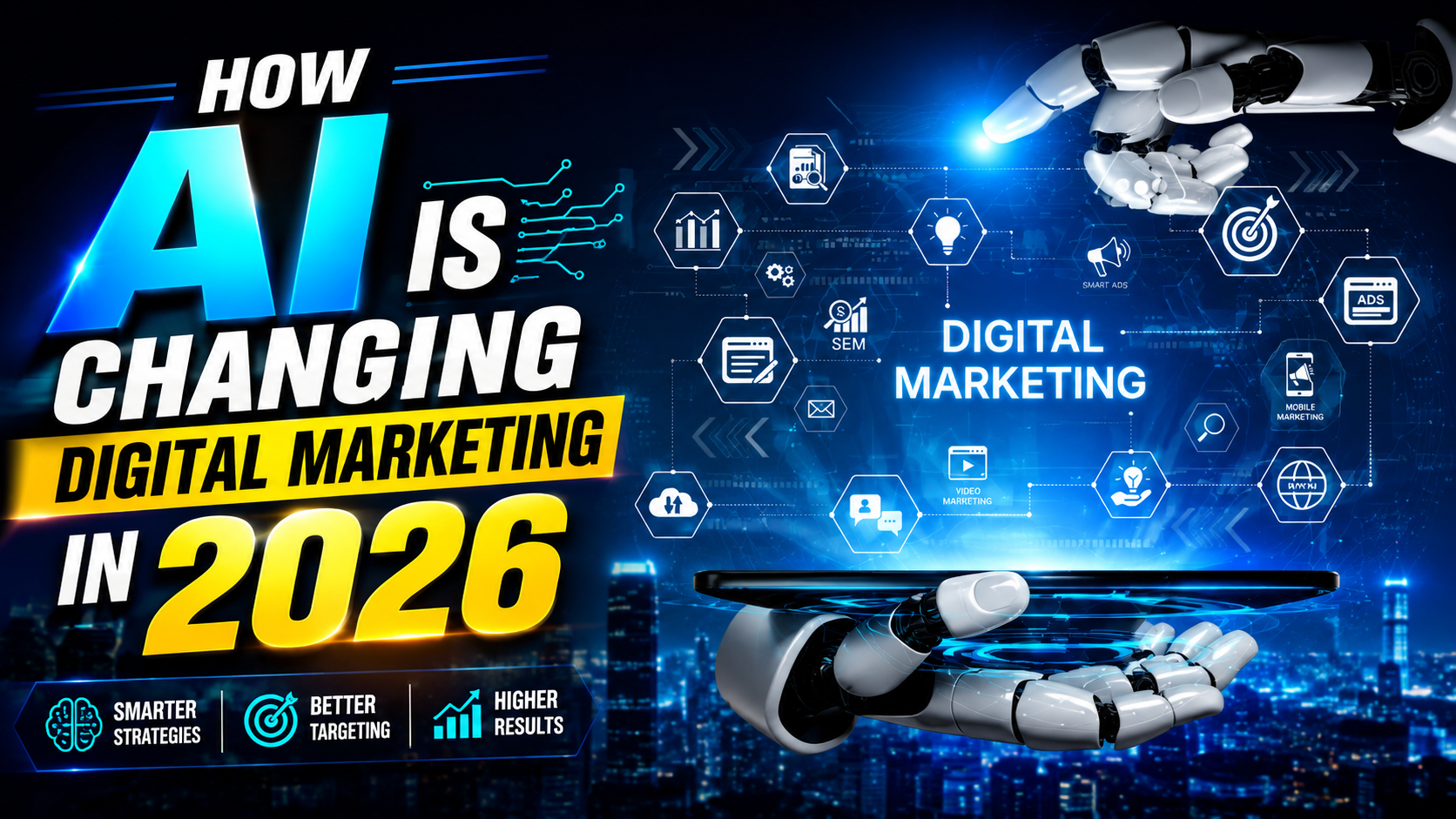
Artificial Intelligence (AI) is no longer just a futuristic technology. In 2026, it has become an important part of how businesses attract customers, create content, run advertising campaigns, analyze data and personalize customer experiences.
For digital marketers, the biggest change is not simply that AI can create content faster. The real transformation is that AI is increasingly helping businesses understand customer intent, make decisions, optimize campaigns and automate repetitive marketing activities.
Google itself describes 2026 as a major shift toward AI-powered discovery, advertising and commerce. Its latest Search developments include AI Mode, AI Overviews and increasingly conversational search experiences. (blog.google)
For businesses looking to grow online, understanding this shift is becoming essential.


What Is AI-Powered Digital Marketing?
AI-powered digital marketing means using artificial intelligence to improve different parts of the marketing process.
Instead of relying completely on manual research, content creation, audience targeting and campaign optimization, businesses can use AI to assist with:
- Content creation
- SEO research
- Customer segmentation
- Advertising optimization
- Social media marketing
- Email marketing
- Lead generation
- Customer support
- Data analysis
- Personalization
- Marketing automation
The important point is that AI does not necessarily replace marketers. Instead, it changes what marketers spend their time doing.
The focus is moving from repetitive execution toward strategy, creativity, customer understanding and decision-making.
1. AI Is Transforming Content Creation
One of the most visible changes is in content marketing.
AI tools can help marketers generate:
- Blog outlines
- Social media captions
- Ad copy
- Email drafts
- Product descriptions
- Video scripts
- Creative concepts
- Headlines
- SEO briefs
This allows small businesses and marketing teams to produce content much faster.
However, there is an important challenge: everyone now has access to AI-generated content.
Simply publishing large quantities of generic AI content is unlikely to create a strong brand.
Research from HubSpot’s 2026 State of Marketing highlights this shift: AI has become widespread, while authenticity, personalization and distinctive brand perspectives remain important differentiators. (HubSpot Blog)
The winning formula
AI + Human Creativity + Brand Expertise = Better Content
AI can provide speed, but humans should provide:
- Experience
- Opinions
- Original insights
- Brand voice
- Storytelling
- Fact-checking
- Creativity
2. SEO Is Changing Because Search Is Becoming More Conversational
Traditional SEO focused heavily on keywords and ranking individual webpages.
But search behavior is evolving.
Google reports that AI Mode queries are significantly longer than traditional Search queries, with the average AI Mode search being around three times the length of a traditional Search query. Google also reports that AI Mode queries have been growing rapidly. (blog.google)
This means businesses need to think beyond:
“What keyword should I rank for?”
and start thinking:
“What question is my customer trying to answer?”
For example, instead of targeting only:
Digital marketing agency
a business could create useful content around:
How can a small business generate 100 qualified leads using digital marketing?
SEO in 2026 should focus on:
- Search intent
- Helpful content
- Original information
- First-hand experience
- Topical authority
- Strong website structure
- Local SEO
- Conversational queries
- Trust and credibility
Google is also providing website owners with new tools and insights for navigating AI-powered Search. (blog.google)
3. AI Is Changing Google Ads and Paid Advertising
Advertising is another area experiencing a major transformation.
AI can analyze enormous amounts of data and help determine:
- Which audience to target
- Which creative to show
- Which search queries to match
- Which budget allocation may work best
- Which campaigns need optimization
- Which users are more likely to convert
Google is expanding AI-powered advertising through products such as AI Max, Gemini-powered creative tools and new AI-driven Search experiences. (blog.google)
Google has also said that AI Max for Search campaigns is expanding, with broader targeting, text customization and URL expansion designed to capture additional opportunities. (blog.google)
This means the role of the digital marketer is changing.
Instead of manually adjusting every campaign element, marketers increasingly need to focus on:
Strategy → Data → Creative → Measurement → Optimization
4. Personalization Is Becoming the New Standard
Imagine visiting an ecommerce website and seeing products specifically selected based on your interests.
Or receiving an email with recommendations based on your previous activity.
Or interacting with a chatbot that understands your previous conversation.
This is AI-powered personalization.
AI can analyze customer information and identify patterns that would be difficult to process manually.
Businesses can use this to personalize:
- Product recommendations
- Emails
- Website experiences
- Advertisements
- Offers
- Customer communication
- Content recommendations
In India, Salesforce’s 2026 research found that 81% of marketers surveyed had adopted AI, while data fragmentation remained a major challenge to effective AI-powered customer engagement. (Salesforce)
This highlights an important lesson:
Good AI marketing requires good data.
5. AI Is Making Customer Support More Intelligent
Chatbots are not new, but AI-powered customer service is becoming considerably more sophisticated.
Modern AI systems can help businesses answer questions about:
- Products
- Services
- Pricing
- Orders
- Appointments
- Frequently asked questions
- Basic troubleshooting
The next stage is moving from simple chatbots to AI agents that can help complete tasks rather than simply answer questions.
For marketers, this can create a faster connection between:
Marketing → Customer Question → Sales → Support
Google’s 2026 developments also point toward more agentic experiences, where AI can help users research information and take actions. (blog.google)
6. Social Media Marketing Is Becoming AI-Assisted
Social media teams can now use AI throughout the content workflow.
For example:
Before publishing
AI can help with:
- Audience research
- Trend analysis
- Content ideas
- Competitor research
During content creation
AI can help create:
- Captions
- Scripts
- Visual concepts
- Short-form video ideas
- Headlines
After publishing
AI can help analyze:
- Engagement
- Reach
- Audience behavior
- Content performance
- Conversion patterns
But brands should avoid making every post look and sound identical.
Human personality is still one of the strongest advantages a brand has.
7. AI Is Changing Video Marketing
Video has become one of the most important digital marketing formats, and AI is making video production faster.
Businesses can use AI-assisted tools for:
- Scriptwriting
- Storyboarding
- Voiceovers
- Video editing
- Subtitles
- Visual generation
- Thumbnail concepts
- Repurposing long videos into short clips
Google’s 2026 advertising updates highlight generative creative tools designed to help advertisers create and scale visual assets more efficiently. (blog.google)
This is particularly useful for small businesses that previously needed a large production budget.
8. AI Is Improving Marketing Analytics
Marketing generates enormous amounts of data.
AI can help marketers understand:
- Which campaigns generate leads
- Which audiences convert
- Which content performs best
- Where customers drop off
- Which channels generate revenue
- Which campaigns need improvement
The future isn’t simply about collecting more data.
It is about turning data into better decisions.
Google’s 2026 marketing developments emphasize unified data, measurement and AI-assisted decision-making as important foundations for growth. (blog.google)
9. AI Agents Could Change Marketing Workflows
One of the most interesting developments in 2026 is the move from AI assistants toward AI agents.
An assistant might help you write an advertisement.
An agent could potentially help manage a larger workflow:
Research → Create → Analyze → Recommend → Optimize
Google has announced information-agent capabilities designed to monitor topics across web sources and provide synthesized updates. (blog.google)
For businesses, this could eventually mean more automated marketing workflows.
However, human oversight will remain important for brand safety, accuracy, strategy and compliance.
10. The Biggest Challenge: AI-Generated Content Everywhere
AI makes content production easier.
That creates a new problem:
Content overload.
When thousands of businesses can generate hundreds of articles, captions and advertisements quickly, producing more content isn’t necessarily the competitive advantage.
The advantage becomes producing better content.
Brands need to develop:
A unique point of view
Don’t simply repeat what everyone else says.
Original experiences
Share real customer stories, case studies and results.
Strong branding
Make your content recognizable.
Human expertise
Add knowledge that generic AI cannot easily reproduce.
Trust
Be transparent, accurate and useful.
AI Will Not Replace Great Marketers — It Will Change Great Marketing
The most successful marketers in 2026 are unlikely to be those who simply use the most AI tools.
They will be the marketers who know where AI should be used and where humans should take control.
A practical model is:
AI handles:
⚡ Repetitive tasks
⚡ Data processing
⚡ First drafts
⚡ Research assistance
⚡ Pattern recognition
⚡ Campaign optimization
Humans handle:
💡 Strategy
💡 Creativity
💡 Brand positioning
💡 Relationships
💡 Original ideas
💡 Final decisions
This combination can create a much more efficient marketing operation.
How Businesses Can Prepare for AI Marketing in 2026
Businesses don’t need to adopt every new AI tool.
Instead, start with a clear strategy.
Step 1: Identify repetitive tasks
Find marketing activities that consume significant time.
Step 2: Introduce AI selectively
Automate tasks where AI can improve speed without sacrificing quality.
Step 3: Improve your data
Connect customer, website, advertising and sales information where appropriate.
Step 4: Build an AI-friendly content strategy
Answer real customer questions with useful, original information.
Step 5: Focus on brand differentiation
Don’t allow your marketing to become generic.
Step 6: Measure business outcomes
Track leads, sales, conversions and revenue—not just impressions.
The Future of Digital Marketing Is Intelligent + Human
AI is fundamentally changing digital marketing in 2026.
Search is becoming conversational. Advertising is becoming more automated. Content production is becoming faster. Personalization is becoming more sophisticated. Customer service is becoming more intelligent. And marketing analytics are becoming increasingly AI-assisted. (blog.google)
But technology alone isn’t the answer.
The businesses that succeed will combine AI efficiency with human creativity, expertise and trust.
The future isn’t simply AI marketing.
It is better marketing powered by AI.
🚀 How Digitalspark4u.com Can Help
At Digitalspark4u.com, businesses can build a stronger digital presence by combining modern digital marketing strategies with AI-powered tools and human creativity.
From SEO and social media marketing to content, paid advertising, branding and digital growth strategies, the goal should be simple:
We Spark Ideas, You Get Results.
If your business is ready to adapt to the AI-driven marketing landscape of 2026, now is the time to start.
Start smarter. Market better. Grow faster.
Frequently Asked Questions
Is AI replacing digital marketers in 2026?
No. AI is automating many repetitive marketing tasks, but strategy, creativity, brand positioning, relationship building and decision-making still require human involvement.
How can AI help small businesses?
AI can help small businesses with content creation, customer support, research, social media, advertising optimization, data analysis and personalization—potentially allowing small teams to accomplish more.
Will SEO disappear because of AI Search?
SEO is changing rather than disappearing. Businesses need to optimize for search intent, useful content, authority, originality and visibility across evolving AI-powered search experiences.
Is AI-generated content good for SEO?
AI can assist with content creation, but publishing generic or inaccurate content at scale is not a strong strategy. High-quality content should add genuine value, accuracy, expertise and a distinctive perspective.
What is the biggest AI marketing trend in 2026?
One of the biggest shifts is the move from AI as a simple productivity tool toward AI-powered marketing systems and agents that can assist with research, content, advertising, analysis and customer engagement.